
Printing onto Fabric
 Looking for a stylish garden shade? View our custom-made canopies…
There are many types of fabric that can be printed onto via a number of printing processes. These processes include inkjet printing, dye sublimation and screen printing (though this is very rare for us now). When deciding on a fabric for printing, there are a number of things to consider before deciding which fabric is most appropriate and which process to use on this fabric. These factors include:

- Is the image colour or black and white?
- Full colour image of text / logo?
- How big is the print and what distance away will it be viewed from?
- Is it going to be back lit?
- Is the image going to be used again and again – at multiple events Or one hit use and replaced regularly?
- Is the print being used outside and being exposed to long periods of UV?
- Do you need to see through the print? Would a mesh print be better?
- What fire rating do you need?
Each of these questions leads to answers that point to a certain fabric printed by a certain process. Here are some overview points to assist you in your consideration:
Printing onto non-absorbent fabric with an Inkjet type process; PVC coated polyester, PVC coated glass, Coated Nylons and other coated fabrics
To print onto non-absorbent fabric, an Inkjet process is often used employing various inks (UV etc). This process involves laying the ink onto the surface of the fabric, where it dries without being absorbed. This results in a print that is vibrant in colour and high in contrast. Therefore this technique and fabric type are generally used for banners, either exterior or exhibition, and are very cost efficient. The disadvantage is that since the colour is on the surface of the fabric it may be easily scratched off, and is therefore not ideal for later re-use.
Printing onto absorbent fabric with an Inkjet type process; cotton canvas, cleval canvas, non-coated nylon
To print onto absorbent fabric an inkjet process can be used, but results can vary depending on the machine and the fabric used. Some contrast and colour vibrancy can be lost, but as printing machines and inks are improving all the time so the result get better. Printing on to absorbent fabrics does mean the risk of being scratched is reduced.
Dye Sublimation
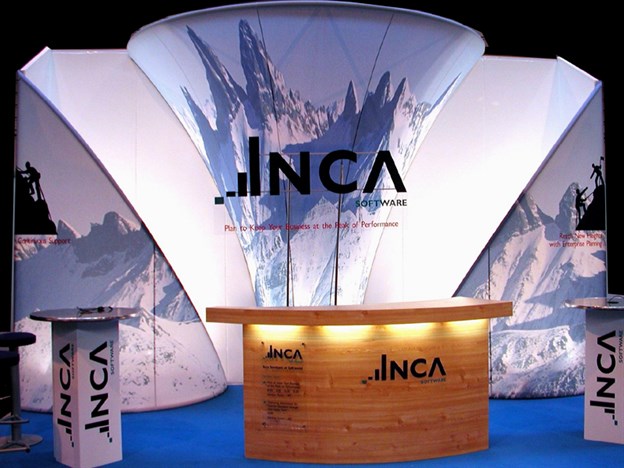 The process of Dye Sublimation involves firstly printing the image onto a paper media. This is then passed through a heat rolling machine with the fabric, where the ink passes from the paper to the fabric and is absorbed into the fabric. This two-stage process means that colours are bright and contrast is high. But perhaps more importantly the print is actually pushed into the fabric, meaning it won't scratch off. It can threrefore be stretched and re-used with very little damage. Costs for dye sublimation are falling fast, so this is commonly becoming the method of choice.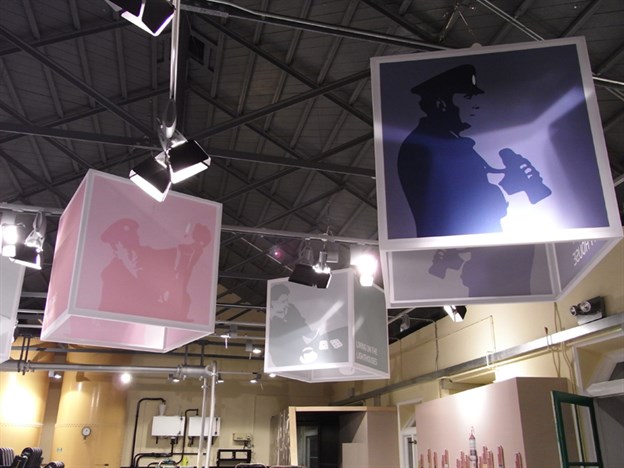
On the right are two example projects which involved the Dye Sublimation printing technique: Inca NEC Birmingham and Lizard Light House.
Our printing requirements
Art work for the purpose of media printing must be supplied in the following formats:
Adobe (Creative suite) Photoshop, Illustrator or Indesign.
We require high resolution, print-ready files. You must turn all text into outline format and supply all fonts. Original files are preferable to PDFs.
For further advice on printing, please contact us.
 Seen our range of pre-designed exhibition products? Easy to specify, use and reuse…
 External canopies made to measure… …and built to last. See our bespoke exteriors portfolio…
 See example uses of tensioned fabric for improved acoustics in our portfolio of bespoke acoustic structures…
 Looking for unique event signage structures? See our bespoke exhibition portfolio…
 Need something a bit out of the ordinary? Interior, exterior and exhibition projects that go beyond the norm…


